
Skin Health
What Are Polynucleotides and PDRN? A Plain-English Guide
Salmon DNA in your skin sounds alarming until you understand what it actually is. A jargon-free explanation of polynucleotides, PDRN, and how they differ.
Medically reviewed by Dr. Maliha Dar, DHA-licensed General Practitioner (licence 29664582-005) · 29 September 2026
In short
Polynucleotides are chains of nucleotides, the building blocks of DNA, purified from salmon for use in skin treatments. PDRN is a shorter-chain form of the same family. Both are used to support the skin's own repair processes rather than to add volume.
Key facts
| Polynucleotides (PN) | Longer chains of DNA building blocks |
|---|---|
| PDRN | Polydeoxyribonucleotide — shorter chains, same family |
| Source | Purified salmon DNA |
| Why salmon | Highly compatible with human tissue, purifiable to high standard |
| What they do | Support repair, hydration and fibroblast activity |
| What they are not | Fillers — they add no volume |
| Common brand names | Rejuran, and other PN/PDRN preparations |
| Not suitable if | Fish or seafood allergy |
If you have researched skin treatments recently you will have run into the terms polynucleotide, PN, PDRN and salmon DNA, often used as though they were interchangeable. They are related but not identical, and the marketing rarely explains the difference.
This is a plain-English explanation of what these ingredients are, where they come from, and what they do — without the biochemistry lecture.
Start with DNA
DNA is built from small units called nucleotides, joined into long chains. That is true of all DNA, in every living thing.
A polynucleotide is simply a chain of those nucleotides. The word is descriptive, not proprietary — 'poly' meaning many, 'nucleotide' being the unit. When a treatment is described as a polynucleotide treatment, it means the active ingredient is chains of these DNA building blocks.
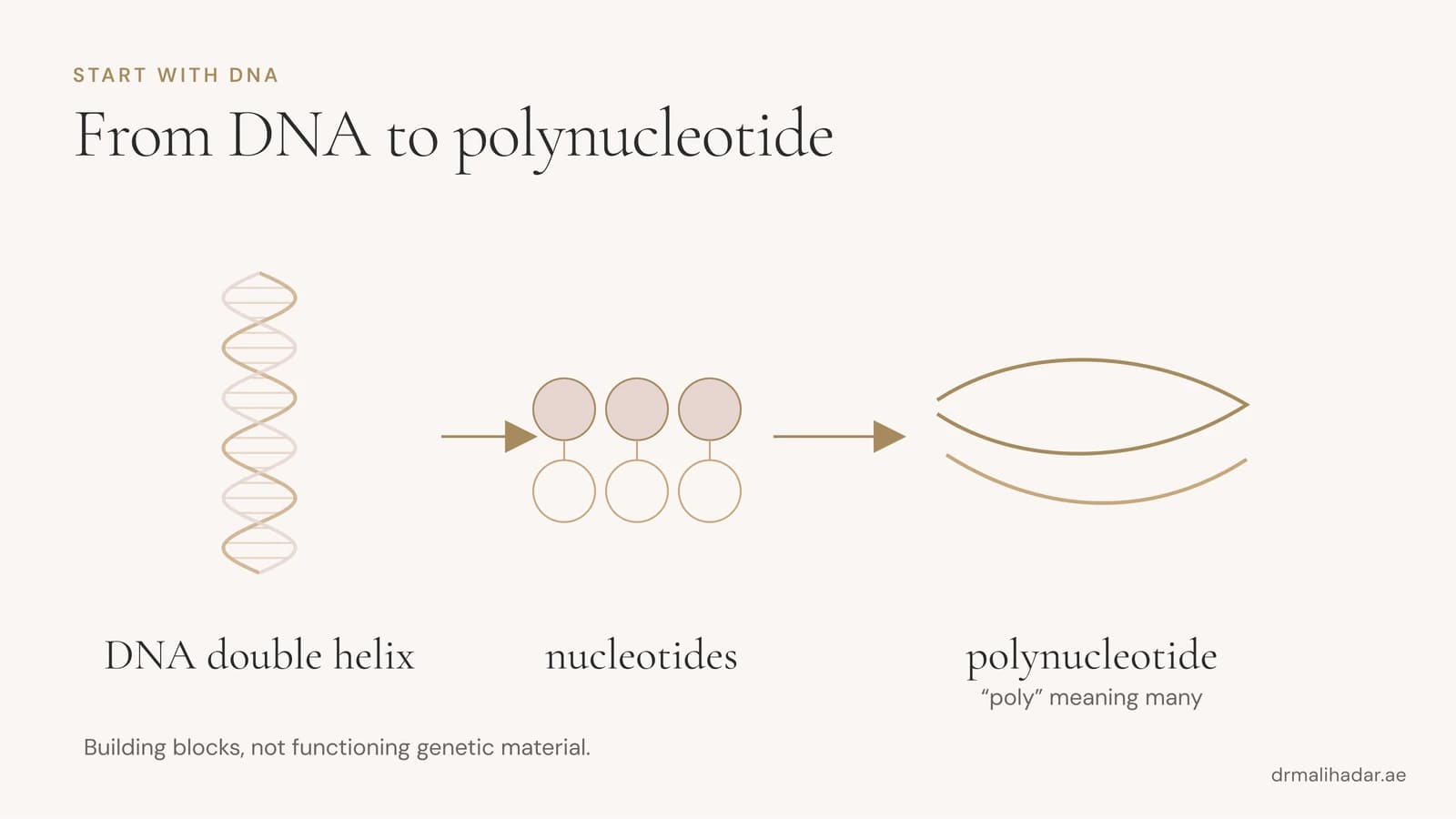
Critically, these are the building blocks, not functioning genetic material. Nothing in the preparation carries salmon genetic information into your cells. The purification process strips out the proteins and other components that would cause a reaction, leaving the structural chains.
This is the point that reassures most people: you are not having fish DNA transplanted into your face. You are having purified biological building blocks placed into the skin, where they act as a scaffold and a signal.
So what is PDRN?
PDRN stands for polydeoxyribonucleotide. It is from the same family, but the chains are shorter.
The practical difference is behaviour in tissue. Longer-chain polynucleotides tend to form more of a physical scaffold, holding water and giving structural support to the skin. Shorter-chain PDRN is generally described as acting more through biological signalling, particularly on repair pathways and inflammation.
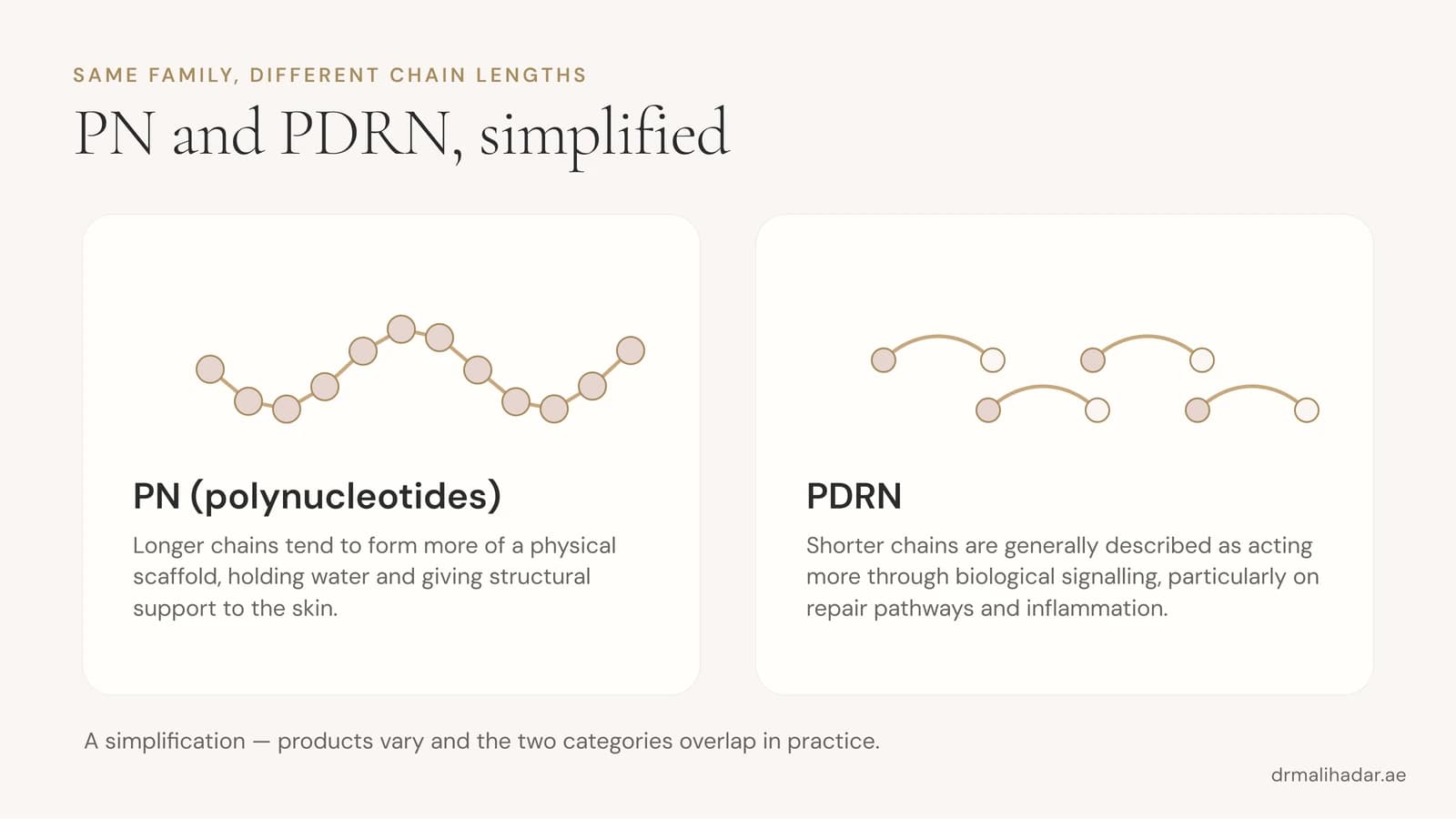
In clinical practice the distinction is less sharp than marketing suggests, and different products sit at different points on that spectrum. Both are used to improve skin quality; neither adds volume.
| Polynucleotides (PN) | PDRN | |
|---|---|---|
| Chain length | Longer | Shorter |
| Emphasis | Scaffold, hydration, structural support | Signalling, repair, anti-inflammatory |
| Source | Purified salmon DNA | Purified salmon DNA |
| Adds volume? | No | No |
| Typical use | Skin quality, texture, elasticity | Repair support, skin quality |
Why salmon?
Two reasons, and neither is marketing.
First, compatibility. Salmon DNA has a structure sufficiently similar to human DNA that the purified building blocks are well tolerated in human tissue, with a low rate of adverse reaction reported in clinical use.
Second, practicality. Salmon is a reliable, traceable and abundantly available source, which allows consistent, high-grade purification at scale. Consistency matters a great deal for an injected product.
The purification process is the part that makes this safe and is also the part that varies between manufacturers — which is a fair thing to ask any clinic about.
What they do in the skin
Once placed into the skin, polynucleotides appear to work in several complementary ways: holding water, which gives hydration from within the tissue rather than on the surface; supporting the activity of fibroblasts, the cells that produce collagen and elastin; and exerting a calming, anti-inflammatory effect on the tissue.
The result is a gradual improvement in how the skin looks and behaves — texture, elasticity, resilience — rather than an immediate visible change on the day of treatment.
This is why these treatments are given as a course and assessed over weeks. If you are expecting the instant change that filler produces, you will be disappointed; that is a different category of treatment entirely.
Common questions about the source
Two questions come up in almost every consultation about these treatments, and both deserve a straight answer.
Where they fit alongside other treatments
Frequently asked questions
- What is PDRN?
- PDRN stands for polydeoxyribonucleotide — shorter chains of DNA building blocks purified from salmon. It is used in skin treatments to support repair and reduce inflammation, and it does not add volume the way filler does.
- Is PDRN the same as Rejuran?
- Not exactly. Rejuran is a brand of polynucleotide treatment. PDRN describes a shorter-chain form of the same ingredient family. Products vary in chain length and formulation, so it is worth asking what specific product is used.
- Where do polynucleotides come from?
- They are purified from salmon DNA. Salmon is used because its DNA structure is well tolerated in human tissue and it can be purified consistently to a high standard for injectable use.
- Am I having fish DNA injected into my face?
- Not in the way that phrase suggests. The purification process removes proteins and other components, leaving structural building blocks. No functioning salmon genetic material is transferred to your cells.
- Are polynucleotide treatments suitable if I have a fish allergy?
- No. The source material is salmon-derived, so these treatments are not suitable for anyone with a fish or seafood allergy. Disclose any allergy at consultation before treatment is planned.
- Are polynucleotide products halal?
- The source is fish rather than porcine or bovine, which is often considered acceptable where those sources would not be. Rulings and personal standards vary, so ask for the specific product details at consultation and verify for yourself.
- Do polynucleotides add volume like filler?
- No. They improve the quality of the skin — texture, elasticity and hydration — without adding structural volume or changing facial contour. If volume loss is your concern, a different treatment category is needed.
- How quickly do polynucleotide treatments work?
- Gradually. Results build over several weeks as the skin responds, and a course of sessions is normally needed. There is no immediate visible change on the day, unlike filler.
- Is there evidence behind polynucleotide treatments?
- Yes, though much of the published research originates in South Korea where the technology was developed, and some is industry-sponsored. Clinical experience is substantial; the independent long-term evidence base is smaller than for older treatments.
- What is the difference between PN and PDRN in practice?
- PN chains are longer and tend to act more as a hydrating scaffold; PDRN chains are shorter and are described as acting more through repair signalling. In practice the distinction is less sharp than marketing suggests.
References
- [1]Journal of Cosmetic Dermatology. Polydeoxyribonucleotide in aesthetic and regenerative dermatology: a review of mechanisms and clinical applications (2023).
- [2]Archives of Plastic Surgery. Effects of Polydeoxyribonucleotide on Skin Rejuvenation and Wound Healing (2020).
This article was last updated on 29 September 2026. Clinical content is reviewed at least every 12 months, and sooner if guidance changes.
Medical Disclaimer
This article is for educational purposes only and does not replace a personalised medical consultation. Treatment suitability varies by individual. Please book a consultation with Dr. Maliha Dar before proceeding with any aesthetic procedure.
Related Articles
 RegenerativeAI image
Rejuran: A Doctor's Guide to Polynucleotide Skin Healing
What Rejuran is, how polynucleotides work, how many sessions it realistically takes, and who it does not suit — from a DHA-licensed General Practitioner.
 Skin HealthAI image
Rejuran vs Profhilo: Which Treatment Suits Your Skin?
They are both injected, neither is a filler, and they solve different problems. A side-by-side comparison of mechanism, course, downtime and who each one suits.