Regenerative
Rejuran: A Doctor's Guide to Polynucleotide Skin Healing
What Rejuran is, how polynucleotides work, how many sessions it realistically takes, and who it does not suit — from a DHA-licensed General Practitioner.
Medically reviewed by Dr. Maliha Dar, DHA-licensed General Practitioner (licence 29664582-005) · 29 September 2026
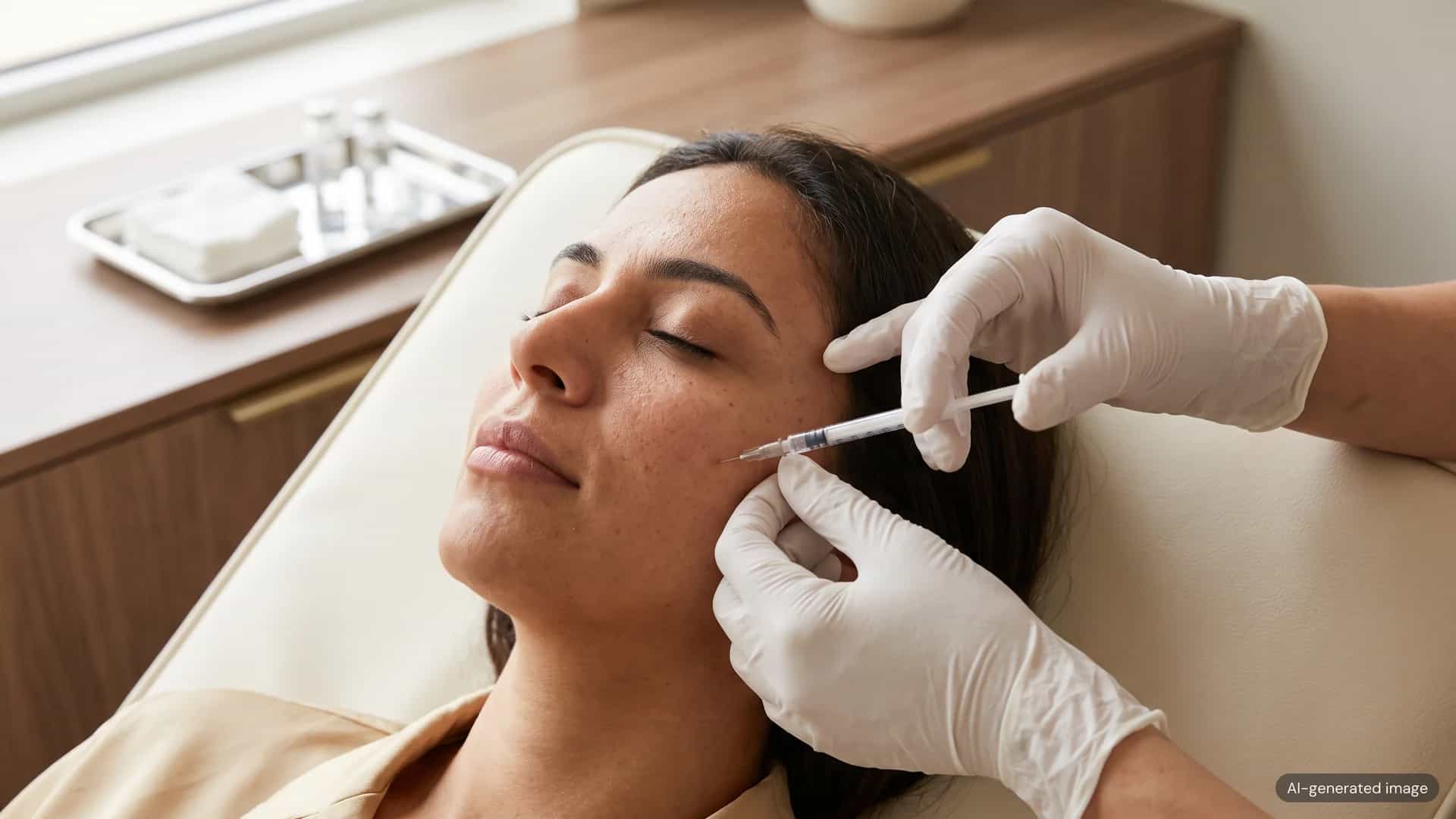
Header image: AI-generated illustration; not a real patient.
In short
Rejuran is an injectable polynucleotide treatment derived from purified salmon DNA. Rather than adding volume, it supports the skin's own repair processes to improve texture, elasticity and hydration. A course of three to four sessions two to four weeks apart is standard, with results building gradually over several weeks.
Key facts
| What it is | Polynucleotides (PN) purified from salmon DNA |
|---|---|
| What it treats | Texture, elasticity, fine lines, skin resilience |
| What it is not | A filler — it adds no volume and changes no contour |
| Session length | 45–60 minutes including numbing |
| Course | Typically 3–4 sessions, 2–4 weeks apart |
| Downtime | Redness and small bumps for 1–2 days |
| Results | Build over 3–4 weeks per session |
| Not suitable if | Fish or seafood allergy, pregnancy, breastfeeding |
| Performed by | Dr. Maliha Dar, DHA-licensed General Practitioner |
Rejuran occupies a category that is frequently misunderstood. It is injected, so patients assume it behaves like filler. It does not. It adds no volume, creates no contour and relaxes no muscle. It works on the quality of the skin itself.
That distinction decides whether you will be pleased with the result. Someone with genuine volume loss who has Rejuran will be disappointed, and someone with thin, dull, crepey skin who has filler instead will be equally disappointed. This guide explains what polynucleotides do, what a realistic course involves, and who should not have it.
What are polynucleotides?
Polynucleotides are chains of nucleotides — the building blocks that make up DNA — purified from salmon. Salmon DNA is used because its structure is highly compatible with human tissue and it can be purified to a high standard, removing the protein content that would otherwise provoke an immune response.
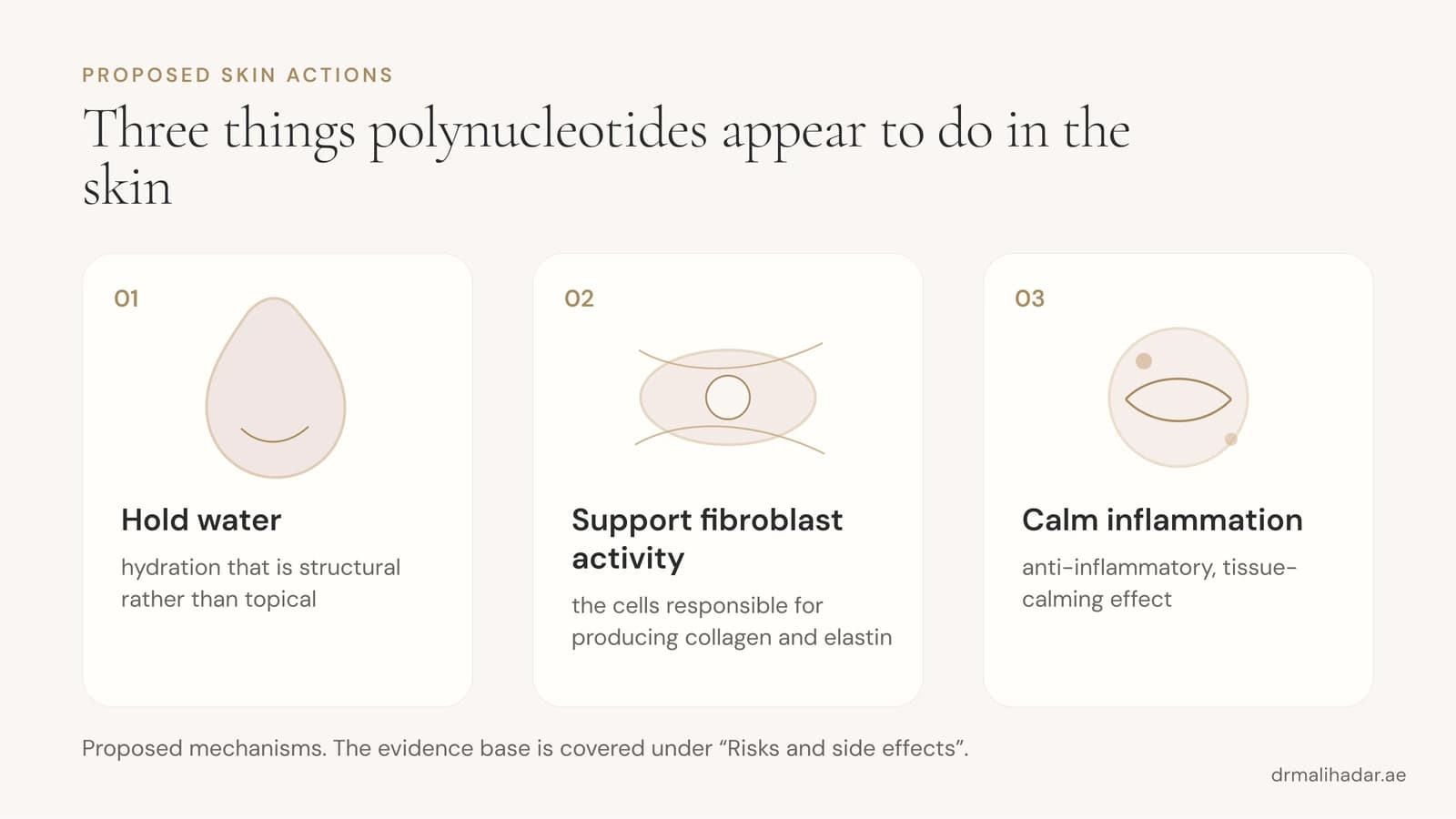
Once placed into the skin, polynucleotides appear to act in three ways: they hold water, giving hydration that is structural rather than topical; they support fibroblast activity, the cells responsible for producing collagen and elastin; and they have an anti-inflammatory, tissue-calming effect.
The intent is to improve how the skin functions rather than to impose a shape on it. This is why results build over weeks rather than appearing on the day, and why a course is needed rather than a single appointment.
Rejuran Face and Rejuran Eye
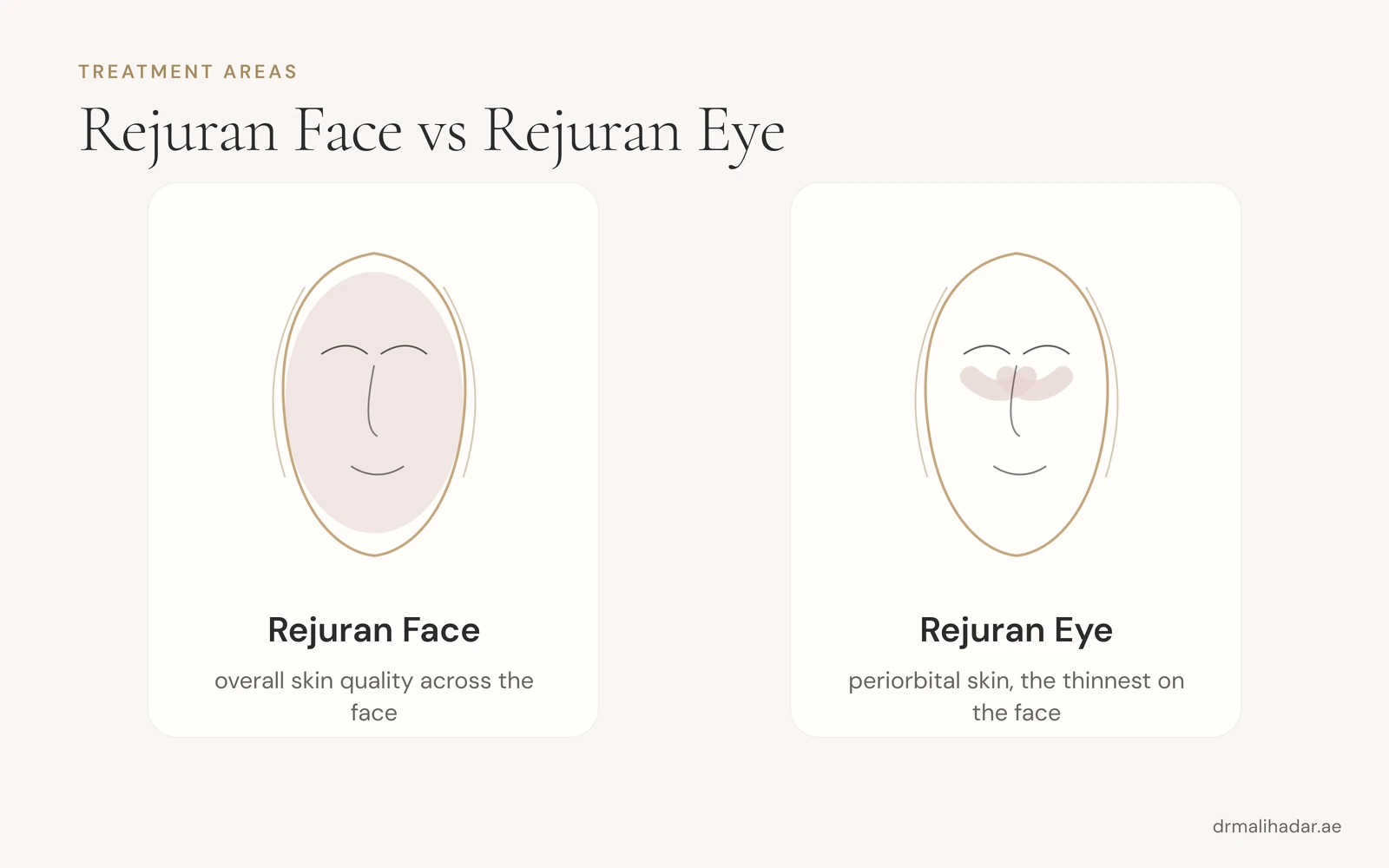
Two formulations are used because the areas they treat are structurally different.
How many sessions, and what the timeline looks like
A standard initial course is three to four sessions spaced two to four weeks apart, followed by maintenance every six to twelve months. A single session will not deliver what the treatment is capable of, and any clinic presenting it as a one-off is overselling it.
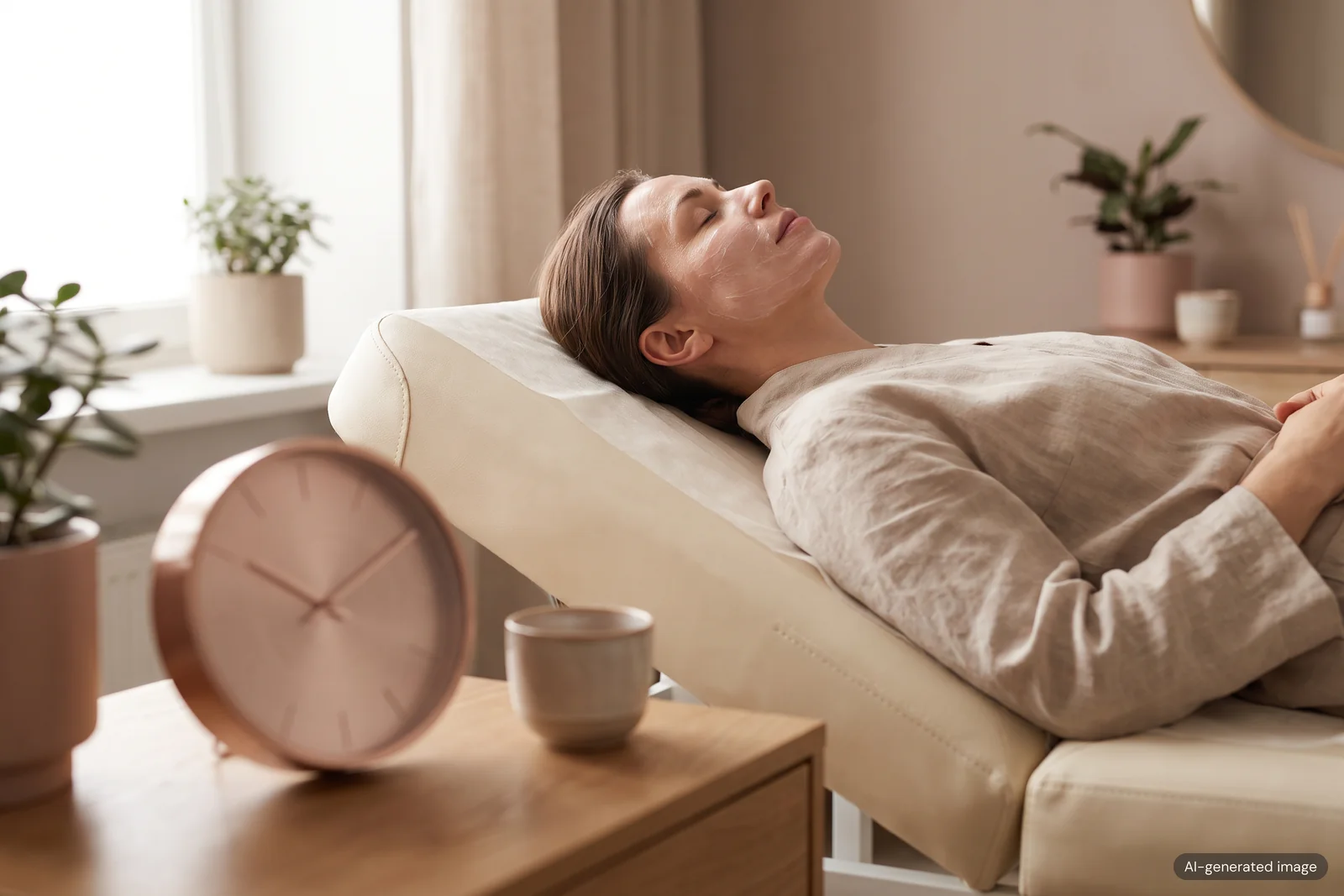
The appointment itself runs 45–60 minutes, most of which is topical numbing for 20–30 minutes before roughly 15–20 minutes of injections.
| Stage | When | What you should notice |
|---|---|---|
| Session 1 | Day 0 | Small bumps settling within 24–48 hours |
| Session 2 | Week 2–4 | Skin feels smoother and better hydrated |
| Session 3 | Week 4–8 | Texture change becoming visible to you |
| Session 4 | Week 6–12 | Elasticity and resilience improved |
| Maintenance | Every 6–12 months | Holds the result rather than rebuilding it |
What to expect immediately afterwards
Expect small raised bumps where product has been deposited. These typically settle within 24–48 hours, though under the eyes they can take slightly longer. Redness is normal for a day or two. Bruising is possible, particularly around the eyes.
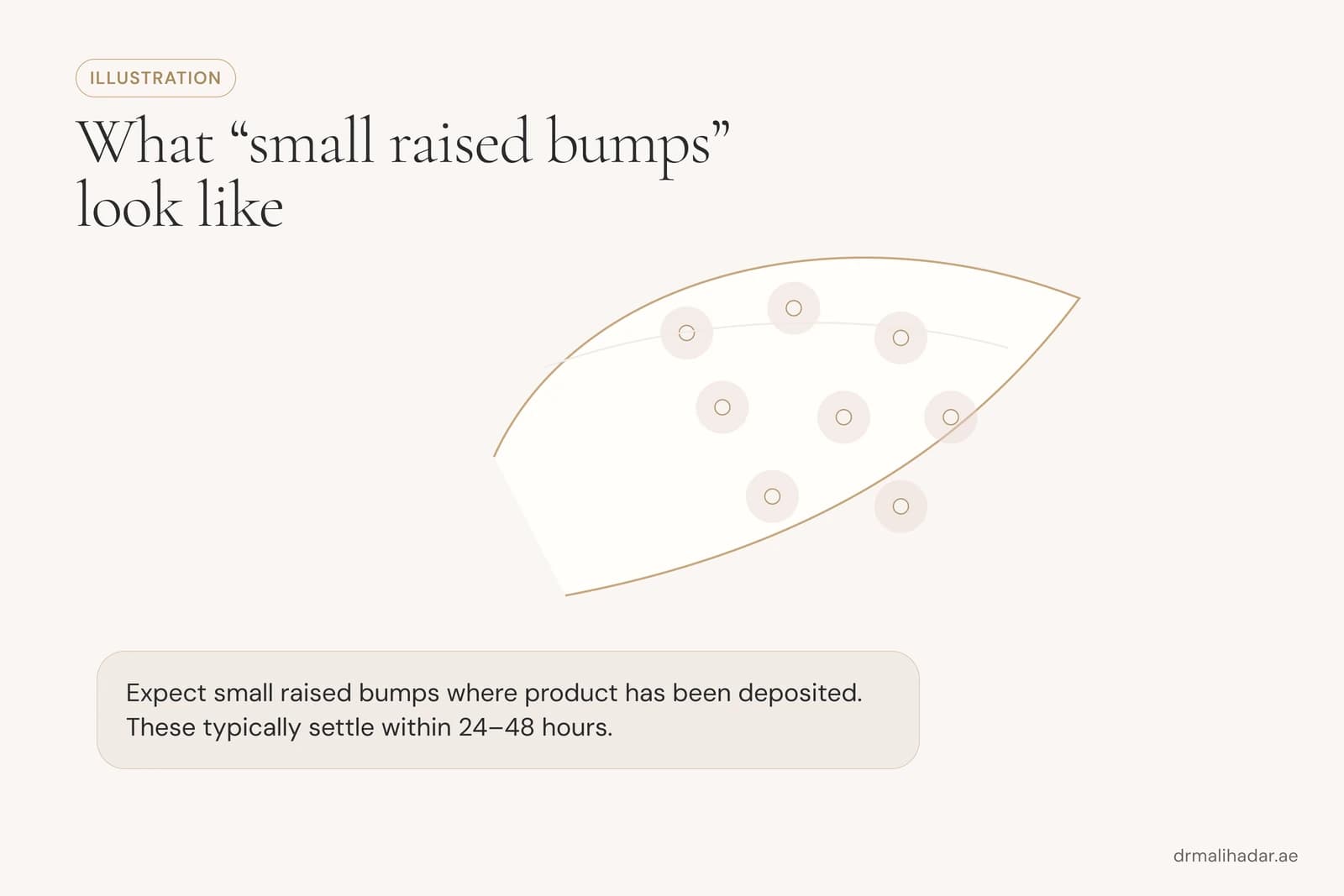
This matters for planning. Do not book a session two days before an event — allow at least a week, and ideally two for periorbital treatment.
Who it suits, and who should not have it
Rejuran suits people whose concern is skin quality rather than volume: dullness, rough texture, early fine lines, loss of elasticity, or thin crepey under-eye skin. It is a reasonable option for those who prefer a regenerative approach over a volumising one, and it can be useful in people who are not good candidates for filler.
It is not appropriate in the following situations, which is why a consultation precedes treatment:
- Fish or seafood allergy — the source material is salmon-derived
- Pregnancy or breastfeeding — safety has not been established
- Active skin infection in the treatment area, including an active cold sore
- Certain autoimmune conditions — raise your full medical history at consultation
- Where the real problem is volume loss or sagging — Rejuran will not address either
- Where expectations are for a lifting or filling effect — that is a different treatment
Risks and side effects
Rejuran is generally well tolerated, but it is an injectable medical treatment and it carries risk.
Expected and temporary: injection-point bumps, redness, mild swelling and tenderness for one to two days. Bruising is common enough to plan around, especially in the periorbital area.
Less common: prolonged swelling, small nodules that take longer than expected to settle, and localised infection. Infection is uncommon with proper technique and aftercare but is the reason the treatment belongs in a licensed clinical setting rather than a salon or a home visit.
A note on the evidence base: much of the published research on polynucleotides originates in South Korea, where the technology was developed, and some of it is industry-sponsored. Clinical experience is substantial and patient satisfaction is generally high, but the independent long-term evidence base is smaller than for older treatments such as botulinum toxin. That is worth knowing before you spend money on a course.
Rejuran in Dubai: practical considerations
Two things are specific to treating skin in this climate. Intense year-round UV means sun protection is not optional aftercare but part of the treatment plan — unprotected exposure undermines the skin-quality gains you are paying for. And the constant movement between outdoor heat and dehumidifying air conditioning places the skin barrier under continuous stress, which is part of why hydration-focused treatment often produces visible change here.
Before booking anywhere, confirm who will perform the injections and that they hold a current DHA licence, ask to see the product packaging before it is opened, and ask what the review arrangement is.
Frequently asked questions
- What is Rejuran?
- An injectable treatment made from polynucleotides purified from salmon DNA. It supports the skin's own repair processes to improve texture, elasticity and hydration, rather than adding volume or changing facial shape the way filler does.
- How many Rejuran sessions do I need?
- Typically three to four sessions spaced two to four weeks apart, then maintenance every six to twelve months. A single session will not achieve the full effect, so the treatment should be planned and priced as a course.
- Does Rejuran hurt?
- Topical numbing cream is applied for 20–30 minutes first, so most people describe the injections as tolerable rather than painful. The treatment involves many small injections and takes roughly 15–20 minutes once numbing has taken effect.
- How long do Rejuran results last?
- Results build over several weeks and are generally maintained for six to twelve months after a completed course. Maintenance sessions hold the improvement rather than rebuilding it from the start.
- Is Rejuran the same as filler?
- No. Filler adds structural volume and changes contour. Rejuran improves the quality of the skin — texture, elasticity and hydration — without adding volume. They address different problems and are often used together rather than chosen between.
- How long is the downtime?
- Small bumps at the injection points usually settle within 24–48 hours, sometimes a little longer under the eyes. Redness lasts a day or two and bruising is possible. Avoid scheduling treatment immediately before an important event.
- Can I have Rejuran if I am allergic to fish?
- No. Rejuran is derived from purified salmon DNA, so it is not suitable for anyone with a fish or seafood allergy. Tell the clinic about any allergy at consultation before treatment is planned.
- Is Rejuran safe during pregnancy?
- It is not used during pregnancy or breastfeeding, as safety has not been established in these groups. Treatment should be postponed, and you should tell the clinic if there is any possibility you are pregnant.
- What is the difference between Rejuran Face and Rejuran Eye?
- Rejuran Eye is a lighter formulation designed for the very thin skin around the eyes, targeting crepey texture and fine lines. Rejuran Face is used more broadly for overall texture, elasticity and pore appearance.
- Will Rejuran get rid of my dark circles?
- Only if the cause is thin, crepey skin allowing underlying vessels to show. It does not fill hollowing, which needs filler, and it does not treat pigmentation. Identifying the cause of your dark circles comes first.
- Can Rejuran lift sagging skin?
- No. Rejuran improves skin quality but does not reposition tissue. Where there is significant laxity or an established jowl, no injectable will lift it, and you should be told that plainly rather than sold a course.
- Can I combine Rejuran with other treatments?
- Often yes, as it addresses skin quality while other treatments address movement or volume. Sequencing and spacing matter for safety and for knowing what worked, so any combination should be planned at assessment.
References
- [1]Journal of Cosmetic Dermatology. Polydeoxyribonucleotide in aesthetic and regenerative dermatology: a review of mechanisms and clinical applications (2023).
- [2]Archives of Plastic Surgery. Effects of Polydeoxyribonucleotide on Skin Rejuvenation and Wound Healing (2020).
- [3]British Association of Dermatologists. Sunscreen Fact Sheet and Photoprotection Guidance.
This article was last updated on 29 September 2026. Clinical content is reviewed at least every 12 months, and sooner if guidance changes.
Medical Disclaimer
This article is for educational purposes only and does not replace a personalised medical consultation. Treatment suitability varies by individual. Please book a consultation with Dr. Maliha Dar before proceeding with any aesthetic procedure.
Related Articles
 Skin HealthAI image
Rejuran vs Profhilo: Which Treatment Suits Your Skin?
They are both injected, neither is a filler, and they solve different problems. A side-by-side comparison of mechanism, course, downtime and who each one suits.
 Skin Health
What Are Polynucleotides and PDRN? A Plain-English Guide
Salmon DNA in your skin sounds alarming until you understand what it actually is. A jargon-free explanation of polynucleotides, PDRN, and how they differ.